


Celiac Disease Pearls (That Many Aren't Aware Of)
Hi Friends,
Dr. Tabibian here.
Celiac disease is a fascinating disorder with many facets, and it’s underdiagnosed…in part because there are some misconceptions out there.
Why You Should Read This
- Celiac disease affects about 1 in 100 people in the U.S.
- Diagnosis may be delayed for years (just this year I diagnosed it in an 83 year-old shortly after I met her for the first time…and within just a few weeks “like a new person”!)
- The standard celiac blood test depends on gluten in your diet, so going gluten-free first can make results look normal.
- Normal blood tests doesn’t necessarily mean that all is well inside.
What Happens in the Small Intestine
Celiac disease is a lifelong immune reaction to gluten, a protein in wheat, barley, and rye. The reaction targets the lining of the small intestine, which is covered in tiny finger-like projections called villi (and microvilli) that help absorb nutrients.
In celiac disease, those villi become inflamed, flattened, and decreased in number, as a result of which absorption and nutrition suffers.
Healthy villi work analogous the little loops on a bath towel, packing in surface area to soak up nutrients (and water, as a matter of fact). With celiac disease, that towel wears down to something closer to a thin sheet, a change we call villous atrophy. Some people feel this change more than others, and in various ways.
The first part of the small intestine— the “duodenum”— typically takes the biggest hit. And it’s the duodenum where the body absorbs most of its iron. Indeed, unexplained iron deficiency anemia is one of the more common ways that routine blood tests can provide a clue as to the presence of celiac disease.
In other words, the first sign of celiac disease sometimes shows up on bloodwork, not in the bathroom nor with abdominal pain.
How to assess for Celiac
- If possible, keep eating gluten until testing is complete (so as to avoid a false-negative).
- Start with blood tests. The usual first step includes a serum tTG-IgA, checked alongside a total IgA level (since low IgA can cause a false negative).
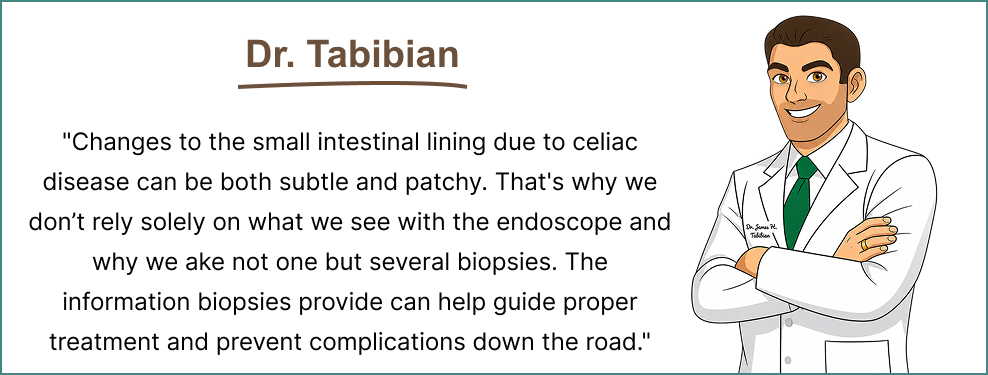
- Confirm with a biopsy. A positive blood test is typically followed by an upper endoscopy, with several small biopsies taken from the duodenum. This may be needed even if blood tester negative, granted there is sufficient reason to suspect possible celiac disease (or another to justify endoscopy).
- Already gluten-free? Genetic testing can help rule celiac disease out, and a supervised gluten challenge—among other measures— can help rule it in.
Takeaway: test first, then change the diet. The reverse order is harder to undo. And if you’re diagnosed with celiac disease, while gluten avoidance is key, it’s not sufficient in and of itself…there are additional aspects to celiac disease management to help keep you healthy.
Until next time,
Dr. Tabibian